
Williams, Mary Lou
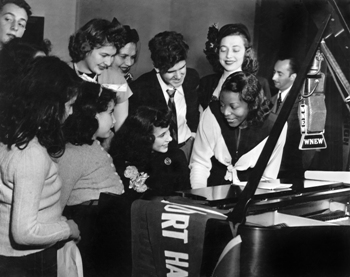
Mary Lou Williams was one of the most important and pioneering women in jazz history. Born Mary Elfrieda Scruggs in Atlanta in 1910, she was a hugely influential composer, arranger, and pianist. She arranged for Duke Ellington and Benny Goodman among others, left a huge catalog of recordings, compositions, and arrangements, performed relentlessly, was a pioneering instrumentalist, a deeply religious person and a dedicated educator, and it's fair to say that she was basically a mentor to the entire bebop era.
Moving to Pittsburgh with her family at an early age, she quickly showed serious musical aptitude, and soon became known around the city as a precocious child prodigy. She eventually began performing with saxophonist John Williams, and they wound up in Kansas City, where Mary Lou would become a huge part of the sound and success of Andy Kirk's Twelve Clouds of Joy. She was a very impressive and formidable stride piano player, with an amazingly fertile and creative mind, and her arrangements helped give the band its distinctive sound.
By the early 1940s she was back in Pittsburgh, continuing to deepen her already impressive reservoir of experience, and she was soon playing in a combo with Art Blakey. Having already come to the attention of Goodman, Ellington, and others and having become in demand as a writer and a beacon of forward-looking jazz ideology, by the mid 1940s she found herself in the epicenter of jazz, New York City.
New York City at the time was going through an incredible period, spearheaded by the evolving bebop movement, led by young players like Thelonious Monk, Dizzy Gillespie, Charlie Parker, Miles Davis, Bud and Richie Powell, Tadd Dameron, and others. Through her commanding and magnetic musical personality, tremendous experience, and endless curiosity and desire to keep moving the music forward, she became a mentor to the younger musicians, holding informal jamming and brainstorming sessions in her apartment.
At this time she was also hosting a radio show and had a regular gig at the Café Society, and she decided to stretch out with something ambitious. This led to one of her landmark works, The Zodiac Suite, which showed off her continuing development and is comprised of a piece devoted to each of the twelve signs. Zodiac was revolutionary, as it was composed for jazz chamber group including woodwinds and strings, and was one of the earliest--if not the first--examples of this type of composition. Always restless for new horizons, in the early 1950s she traveled to Europe, where she recorded and toured for a couple of years. Upon returning to the States, her deepening spirituality led her to convert to Roman Catholicism, which was to be a very central part of the remainder of her life; as the blues and depth of feeling were always central to her very being, this was a seemingly very natural progression.
Her conversion and awakening led her to retire from music for a few years, and she was eventually coaxed back by Gillespie, with whom she performed at the Newport Jazz Festival in 1957. This personal evolution led her to begin serious charitable endeavors, and she built a organization that also included her very own record label and thrift stores. She began composing sacred works, leading to Alvin Ailey choreographing a work to her music, which became the widely-known Mary Lou's Mass, which was eventually the first jazz piece performed at New York City's St. Patrick's Cathedral.
While her music in the 1960s focused on the spiritual, she remained very active. Peter O'Brien, a Jesuit preparing for the priesthood, introduced himself to her and became her close friend and manager. She remained busy playing and recording, continued to run her own record label and publishing company, was instrumental in founding the Pittsburgh Jazz Festival, and intensified her efforts to help provide for the needy of the music world, with her thrift stores raising money while she contributed part of her earnings directly as well.
Always deeply involved in education, she moved to Durham, North Carolina to take a teaching position at Duke University in 1977, teaching jazz history and leading ensembles, while still conducting clinics and performing as well. Near the end of her life, she founded the Mary Lou Williams Foundation, which became the guardian of her musical legacy and for decades was run by Father O'Brien, with an emphasis on jazz education for the young.
Mary Lou Williams passed away from cancer on May 28, 1981, at the age of 71 in Durham. Her funeral was attended by Goodman, Gillespie, and more jazz royalty. A truly rare musical figure, she was at her core a stride pianist, who did not simply adjust to the advent of swing and the revolution of bebop, but jumped to the intellectual forefront of both. The new eras looked to her for guidance, and she rewarded them with the leadership that would help give some of their biggest names more ammunition with which to drive the music forward. A wonderful quote from her New York Times obituary lets her sum herself up ideally: "'No one can put a style on me,'' she told Whitney Balliett of The New Yorker. ''I've learned from many people. I change all the time. I experiment to keep up with what is going on, to hear what everybody else is doing. I even keep a little ahead of them, like a mirror that shows what will happen next.'' Never one to rest for long, she surged forward into decades of renewed dedication to faith and education, and left indelible legacies there as well.
Mary Lou Williams was a truly great and brilliant woman. During a time when very few women ventured into the arenas she did, she not only succeeded, but excelled at the highest levels. Her writing, playing, musical ideas, and counsel were intensely sought after and valued by names which would become some of the biggest and most important in American music history. The depth and breadth of her heart, mind, and soul were such that she also had major impacts in religious, charitable, and educational spheres as well.
Father O'Brien worked diligently for decades to further her legacy and keep her music alive and thriving, and Jazz Lines Publications is extremely proud to have been given the privilege and responsibility of being a part of that effort. Peter was a kind, generous man who we were blessed to know. It was via his cooperation that we were able to access some of Mary Lou's best and most important music, which we humbly publish today.

MARY LOU WILLIAMS JAZZ LINES PUBLICATIONS SERIES: EIGHT ARRANGEMENT SET
Eight Jazz Big Band Arrangements
Jazz Lines Publications
JLP-1036
$450.00
ARIES MOOD (PORTRAIT OF BEN WEBSTER)
Recorded by the Dutch Jazz Orchestra
Jazz Big Band Arrangement
Jazz Lines Publications
JLP-8783
$55.00

ARIES MOOD (PORTRAIT OF BEN WEBSTER) [DOWNLOAD]
Recorded by the Dutch Jazz Orchestra
Jazz Big Band Arrangement
Jazz Lines Publications
JLP-8783-DL
$55.00

Recorded by Andy Kirk
Jazz Little Big Band Arrangement
Jazz Lines Publications
JLP-8784
$55.00
Recorded by Andy Kirk
Jazz Little Big Band Arrangement
Jazz Lines Publications
JLP-8784-DL
$55.00
Recorded by the Duke Ellington Orchestra
Jazz Big Band Arrangement
Jazz Lines Publications
JLP-7654
$75.00
BLUE SKIES (TRUMPETS NO END) [DOWNLOAD]
Recorded by the Duke Ellington Orchestra
Jazz Big Band Arrangement
Jazz Lines Publications
JLP-7654-DL
$75.00
![CAMEL HOP [DOWNLOAD]](https://www.ejazzlines.com/wp-images/product/thumbnail/camel_hop_jlp-8792.jpg)

Recorded by Benny Goodman
Jazz Big Band Arrangement
Jazz Lines Publications
JLP-8792-DL
$75.00
Performed by Mary Lou Williams
Jazz Big Band Arrangement
Jazz Lines Publications
JLP-8780
$55.00
Performed by Mary Lou Williams
Jazz Big Band Arrangement
Jazz Lines Publications
JLP-8780-DL
$55.00
Recorded by Dizzy Gillespie
Jazz Big Band Arrangement with Vocal
Jazz Lines Publications
JLP-8785
$75.00
IN THE LAND OF OO-BLA-DEE [DOWNLOAD]
Recorded by Dizzy Gillespie
Jazz Big Band Arrangement with Vocal
Jazz Lines Publications
JLP-8785-DL
$75.00
Written for Benny Goodman
Jazz Big Band Arrangement
Jazz Lines Publications
JLP-8820
$75.00
Written for Benny Goodman
Jazz Big Band Arrangement
Jazz Lines Publications
JLP-8820-DL
$75.00
Written for Duke Ellington
Jazz Big Band Arrangement
Jazz Lines Publications
JLP-8776
$75.00
Written for Duke Ellington
Jazz Big Band Arrangement
Jazz Lines Publications
JLP-8776-DL
$75.00
Recorded by Andy Kirk
Jazz Little Big Band Arrangement
Jazz Lines Publications
JLP-8787
$55.00
Recorded by Andy Kirk
Jazz Little Big Band Arrangement
Jazz Lines Publications
JLP-8787-DL
$55.00
Recorded by Andy Kirk
Jazz Big Band Arrangement
Jazz Lines Publications
JLP-8786-DL
$75.00
![MELLOW BIT OF RHYTHM, A [DOWNLOAD]](https://www.ejazzlines.com/wp-images/product/thumbnail/mellow_bit_of_rhythm_jlp-8794.jpg)
MELLOW BIT OF RHYTHM, A [DOWNLOAD]
Recorded by Andy Kirk
Jazz Big Band Arrangement
Jazz Lines Publications
JLP-8794-DL
$75.00
![MESSA STOMP [AKA MESS A STOMP - 1929 VERSION]](https://www.ejazzlines.com/wp-images/product/thumbnail/messa-l.jpg)
MESSA STOMP [AKA MESS A STOMP - 1929 VERSION]
Recorded by Andy Kirk
Jazz Small Group Arrangement [6 Horns with Rhythm Section]
Jazz Lines Publications
JLP-8779
$55.00