
FACE THE MUSIC
Irving Berlin
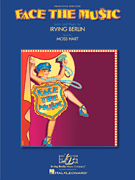

Cat #: 00313394
Retail Price: $16.95
Our Price: $15.26
This item usually ships within 5 to 7 business days.
Questions?
Please call +1-518-587-1102 or email us.
Edition: Paperback Book, Piano/Vocal
Description: 104 Pages
Piano/vocal arrangements of 18 gems from this 1932 Broadway musical revue, Irving Berlin's first collaboration with Moss Hart.
Crinoline Days
How Can I Change My Luck?
I Don't Want To Be Married (I Just Wanna Be Friends)
I Say It's Spinach
If You Believe
Let's Have Another Cup Of Coffee
Lunching At The Automat
Manhattan Madness
My Beautiful Rhinestone Girl (My Rhinestone Girl)
(Castles In Spain) On A Roof In Manhattan
The Police Of New York
Reisman's Doing A Show
Soft Lights And Sweet Music
A Toast To Prohibition
Torch (Torch Song)
Two Cheers Instead Of Three
Well, Of All The Rotten Shows
You Must Be Born With It
How Can I Change My Luck?
I Don't Want To Be Married (I Just Wanna Be Friends)
I Say It's Spinach
If You Believe
Let's Have Another Cup Of Coffee
Lunching At The Automat
Manhattan Madness
My Beautiful Rhinestone Girl (My Rhinestone Girl)
(Castles In Spain) On A Roof In Manhattan
The Police Of New York
Reisman's Doing A Show
Soft Lights And Sweet Music
A Toast To Prohibition
Torch (Torch Song)
Two Cheers Instead Of Three
Well, Of All The Rotten Shows
You Must Be Born With It
You May Also Like
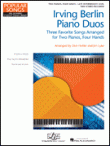
Three Favorite Songs Arranged for 2 Pianos, 4 Hands
Paperback Book, Piano Duo
00296838
$14.95
Our Price: $13.46
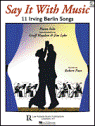
SAY IT WITH MUSIC: 11 IRVING BERLIN SONGS
Piano Solo with CD
Paperback Book & Cd Package, Solo Piano
00372429
$10.95
Our Price: $9.86


Piano Play-Along Volume 42
Paperback Book & CD Package, Piano
00311239
$14.95
Our Price: $13.46
![BLUE SKIES [DOWNLOAD]](https://www.halleonard.com/common/item_gif/07010878.gif "BLUE SKIES [DOWNLOAD]")


