
BODY AND SOUL
As Recorded by Rob McConnell and the Boss Brass
Arranged by Rob McConnell, Prepared for Publication by Dylan Canterbury, Rob DuBoff, and Jeffrey Sultanof
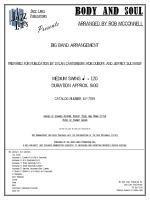

Cat #: JLP-7019
$85.00This item usually ships within 1 business day.
Questions?
Please call +1-518-587-1102 or email us.
Edition: Jazz Big Band Arrangement
Description: Swing - Advanced
Publisher: Jazz Lines Publications
Rob McConnell's arrangement of Body and Soul sees his normally explosive style swapped for a disarmingly mellow approach. The melody and form of the tune is stretched out to imply a double time ballad feel, enhanced by the bass maintaining a casual 2-beat throughout the performance, and the intensity level should never rise too high, even during the more technically demanding portions of the chart. This was recorded in 1976 and released on McConnell's album The Jazz Album.
A mellow chorale of low brass and woodwinds sets the stage at the top before McConnell enters with the melody at measure 9. The accompaniment largely maintains a chorale-like feel for the first A section, with the second seeing a slight increase in activity. McConnell drops out for the bridge, where some lush ensemble writing coasts atop a Giant Steps-inspired reharmonization before giving way to Guido Basso's flugelhorn for the back half of the melody at measure 49. The saxes take command of the spotlight at measure 73 for a lengthy and demanding soli section, converging with the brass at measure 105 before splitting back off at measure 121.
Once the saxes wrap up, the arrangement becomes an extended feature for longtime Boss Brass guitarist Ed Bickert at measure 137. The backgrounds are sprightly and never invasive, and this section can be easily opened up for additional choruses should you wish to showcase your guitarist, or possibly add other soloists. At measure 201, a band-within-a-band consisting of alto and tenor sax, flugelhorn, and trombone carry out a tricky soli section (including a sly quote from Horace Silver's Ecaroh) that should be climactic, but not overwhelming. Once the ensemble reaches the bridge, the arrangement is copied from earlier, ultimately concluding with an extended tag that leads to a warm, cozy finale.
Included are additional trumpet and trombone parts that may be used in place of the horns in F. Also, the percussion part was not in McConnell's original score and appears to have been added at a later date, and can effectively be considered optional.
This publication was prepared from Rob McConnell's pencil score and the original set of parts used for the 1976 recording session - this is not a transcription.
Woodwind 1: Clarinet/Flute/Alto Saxophone
Woodwind 2: Alto Saxophone/Flute
Woodwind 3: Tenor Saxophone/Flute
Woodwind 4: Tenor Saxophone/Clarinet
Woodwind 5: Baritone Saxophone/Bass Clarinet
5 Trumpets (Trumpets 3-5 Double on Flugelhorn)
4 Trombones
Bass Trombone
Guitar
Piano
Bass
Percussion: Vibraphone/Xylophone
Drum Set
Trombone 1: Bb4
You May Also Like


![HEY! [DOWNLOAD]](https://www.ejazzlines.com/wp-images/product/thumbnail/w51359.jpg)

