
Richards, Johnny
We have acquired many of Johnny Richards's arrangements and will be publishing them over time. We also spent considerable time researching his life and present below an accurate portrait of this brilliant musical mind.
Johnny Richards was one of leading modernist voices in jazz composition and arranging in the 20th Century. His music was known for being complex, demanding, and always forward thinking. He also led a complex life, in which even his closest companions could not distinguish between fact and fiction. Perhaps in an attempt to obscure his Mexican origins due to racism and fear of deportation, the fact that he received much of his music education from his mother, and was largely self-taught in composition, he fabricated many biographical details.
Family Background:
Johnny Richards was born Juan Manuel Cascales in Toluca, Mexico on November 2, 1911 to parents of means who were of Spanish descent. His father, Juan Cascales y Valero, was a merchant, born in 1879 in Fortuna, Spain and emigrated to Mexico. His mother, María Celia Arrúe de Cascales, born in 1884, was from a well-to-do family from Querétaro, Mexico. She showed talent for music from an early age and her father facilitated her studies with the best teachers available. She was an accomplished pianist and violinist, played numerous wind instruments, and was knowledgeable about composition.
The Cascales family emigrated to the United States during the Mexican Revolution. Richards's father first entered the US at Laredo, Texas in June, 1919 and Maria arrived with their five children in early August. At the time they were only given temporary visas - long enough for Maria to see doctors for her hearing loss. The family then traveled to California, settling in Los Angeles.
The family relocated to San Fernando in 1921 and resided across the street from San Fernando High School, from which Richards was graduated in 1929. From an early age, Richards's mother provided music instruction to her children. While at middle school and high school, Richards was involved in student government, the glee club, as well as numerous musical groups (playing the clarinet). He also was on the football team and in the Boy Scouts serving as a bugler.
Richards's father often traveled for work during the 1920s but sadly lost his ability to support his family during the onset of the Great Depression of 1929. Early in 1930, he left the family with the explanation that he did not want to burden his wife, who was by then supporting the family as a music teacher. He was never seen nor heard from again. Richards enrolled at Fullerton College in September 1929 and completed one year as a music and education major. He was living alone in Fullerton in 1930 when the census was taken, and he declared his place of birth to be France and that the language spoken at home was French. This was the first example of him altering his past to potentially hide his Mexican heritage. In fact, in that same 1930 census taken at his mother's house, she indicated that she was from France and the language spoken at home was French. She also indicated that her son Johnny (enumerated in the census records at his mother's home as well as his own) was also born in France, but told the census taker that her other children were born in Spain. Richards's mother Maria had adopted France as her birthplace as a way to avoid deportation, and her son may have simply followed suit. During that time period, many aspiring musicians, dancers, and actors with ethnic-sounding names would change them in an effort to gain widespread acceptance. Richards's high school diploma was awarded to John Richard Cascales, the name he had begun using, and he entered Fullerton College by that name.
Early Career:
In the early 1930s, Richards led his own band under the name Johnny Cascales Orchestra. He also served as musical director for the Teddy Joyce Orchestra, as well as the Marvin George Orchestra. In 1934 he married Canadian national Evelyn 'Lynne' Barnes who was an actor on stage and in film. In 1935 Richards began an association with Warner Brothers and in several articles was referred to as having a popular studio and radio orchestra of eight pieces and a vocalist. It was during this time that he began his association with composer and arranger Victor Young at Paramount Pictures. It's not clear whether Richards composed, arranged, or orchestrated while working for Young. It's possible that he worked in all three disciplines. On a side note, Richards's brother Joe Cascales was working for Paramount in their music division.
Richards was a member of John Scott Trotter's Orchestra by 1937, and accompanied Bing Crosby on the Kraft Music Hall radio program. In 1938 Richards's band consisted of musicians who had previously played with Crosby, Eddie Cantor, and Al Jolson. Richards continued to perform on saxophone with Trotter's Orchestra for both Crosby and Cantor's weekly radio program in 1939, and had his own nightly radio broadcast on station KHJ. Through his association with Victor Young he participated in several film recording sessions including the Bing Crosby movie The Road to Singapore and the orchestration for Army Girl, for which Young was nominated for the Oscar for best music scoring. In an article from 1939 Richards mentioned that he had been working with Young for four years. Richards's composing and arranging work for MGM had noteworthy successes such as his arrangement of Our Love Affair for the movie Strike Up the Band, sung by Judy Garland and nominated for an Oscar. He also contributed the arrangement of Little Curly Hair in a High Chair for the Eddie Cantor movie Forty Little Mothers. He played saxophone on The Modernettes recording of Sweet Sue, Just You, from a Soundie that was billed as Lorraine Page and her band, Six Hits and a Miss. He observes in an article about his KHJ show that, “Every one is playing my arrangements except myself.” Richards would continue to collaborate with leading musicians, but around this time he begins working toward accolades under his own name.
The first example of him using the name Johnny Richards appears in 1940. In an interview about his new orchestra, the Casa Mañana Band, from this year, Richards says that at age 17 he played with Paul Whiteman and that he changed his name because his brother Charles (Chuck) also had a local band using Cascales name, leading to confusion for the concert-going public. His Casa Mañana band was made of musicians from Trotter and Victor Young bands. In October 1940 when Richards registered for the draft, he listed his employer as General Amusement Corp, which was Bing Crosby's entertainment company.
Richards applied for citizenship in 1941 using his given name of Juan Manuel Cascales but also indicated his stage name John Richard Cascales. Throughout the year of 1941 his Casa Mañana band led many engagements and also backed the Andrews Sisters for a variety of dates around the Los Angeles area. Throughout the following year he continued performing in Los Angeles and was cited for being the top arranger for most of the radio shows coming out of Hollywood. Dave Hyltone gave the band a middling review for Metronome in March of 1942, but praised Richards saying, “Johnny Richards is a fine musician himself and rates as one of the top clarinetists on the coast...This band has done superior work in the past and shows a lot of promise for the future. In the present state, however, Johnny Richards will merely coast along. As heard on the air several times, the men do not seem to have the same spirit as their leader.”
Becoming Johnny Richards, Modern Composer and Band Leader:
By mid-1943 Richards moved to New York City and was leading a 30-person orchestra appearing on regular radio broadcasts. He resigned from Paramount in 1944 to focus on his band, according to Ben Gross (The Daily News). In 1945 he married Blanca Webb. Their son Joe would go on to become a musician and actor, starring in the original Broadway production of Hair and co-writing with Peter Tork of The Monkees. The following year, Richards' brother Joe Cascales, who spent seven years working for Columbia Broadcasting Company's staff orchestra, and was vice-president of Paramount Records, died at the age of 36 from a cerebral hemorrhage. Changes in his family life notwithstanding, Richards continued to refine his style, and in 1946 was hired by Boyd Raeburn to write arrangements and original compositions for Raeburn's ensemble. In 1948 Richards was hired by Harry James and contributed arrangements to his book as well. Around this time he was also working with Charlie Barnet's big band, contributing an arrangement of Rhapsody in Blue that the Gershwin family successfully banned. In 1950, he accepted a position with Discovery Records. Among his assignments was to arrange and conduct for Dizzy Gillespie. Richards described their goals, “Dizzy and I were trying to get this album into the homes of the people who had never accepted Gillespie before. As a result we were trying to prove only that modern music could be done with taste.” It was around this time that writer Ted Kovach compared Richards' arranging as parallel to the work of Debussy, recalling an evening when “Igor Stravinsky walked into a Hollywood night spot in 1947 to hear what everyone was talking about; the arrangements of Johnny Richards. The always silent Igor just stared while his mouth hung open.”
Collaboration with Stan Kenton:
Richards began an association with Stan Kenton in 1950 that would last over ten years – and in 1952 he moved from California to New York. At this point, Richards was in his forties. He had worked with legendary musicians and established himself as a composer, arranger, and band leader. He had also spent decades developing his musical voice and studying the music of the Latin world, honing a style uniquely his own. He contributed many forward thinking arrangements to Kenton's book, but perhaps the most critical impact on Richards's own career came from Cuban Fire, recorded in 1956. Kenton's goal was to produce a record with more authentic Latin style, and Richards delivered. Bill Coss interviewed Richards while writing the liner notes.
The idea had already begun to grow then, although it had no real form until South American friends began to send him tribal records. "These records," Richards told me as we sat in the recording studio, "utilized instruments that hadn't yet been developed here. That was when I really got interested, when I could analyze these things in the relative objectivity of my living room. Friends in New York took over then, and I'd like to pay some sort of tribute to people like Willie Rodriguez who seemed to anticipate just what I had to hear to fill in the gaps. [Willie led the Latin rhythm section on this date.] He and his friends took me to dances, weddings, festivals and quite literally introduced me to every aspect of the Latin American musical life available in New York City. I spent those several weeks not writing a note of music, just listening and asking questions. out of it all came the six ritual dances which we're recording now, Ritual dances to which I've composed American music without losing the basis of the dances themselves."
Coss goes on to say, “It's doubtful that the Kenton band has ever sizzled before as it sizzles here, or that Johnny Richards has ever written so objectively and vitally, or that all the many gears inside the gears which go into making a record have ever meshed so cleanly and with such finality... Future writing about Richards will certainly list this album with the Kenton orchestra as representative of his best: relating personal concepts to traditional folk rhythms.” Others noted that the “LP stands as a watershed set of compositions for Johnny Richards's career and an outstanding commercial/artistic achievement for the Kenton orchestra, and a singular landmark in large ensemble Latin jazz recordings. Ted Darryl notes that “The success of the Cuban Fire! album can be gauged in part by the immediate ascent of Johnny Richards's star after its release; he was suddenly offered a contract by Bethlehem Records to record what would be the first of several recordings with his own groups.”
Throughout the 1950s and 1960s, Richards led his own orchestra, releasing eight records between 1955 and 1967. Barry Ulanov wrote liner notes for Annotations of the Muses, released in 1955, observing that “There has been much talk in recent years about the close relationship between jazz and what is usually called classical music (or sometimes "serious music", as if jazz musicians were kidding). They're coming closer and closer together, this talk usually goes. It's getting so you can't tell where one leaves off and the other begins, somebody says – wistfully, as if it where sinful or something to be ashamed of. And then somebody else – me, if I'm part of this familiar conversation – asks what all the sad words are about; why such viewing with alarm; why the dissatisfaction; it's music, isn't it?”
Richards continued to build his style, releasing Something Else by Johnny Richards (1956), Wide Range (1957) contains The Ballad of Tappan Zee, described by J.C. Thomas in Downbeat as “the composition that, in terms of precision, warmth, and tone color, best highlights Richards’s skills.” Nat Hentoff wrote the liner notes to Wide Range, noting that, “Johnny Richards is a writer who likes to challenge his men and himself through a wide range of sounds and colors and he usually finds the sidemen who can fulfill his designs.” Experiments in Sound was released in 1958 (again with liner notes written by Nat Hentoff), and Richards followed up with Rites of Diablo in 1958, Walk Softly/Run Wild (1959) and My Fair Lady – My Way (1964).
At the same time, he was composing and arranging for others including the score for the 1959 film Kiss Her Goodbye, filmed in Cuba and confiscated by Fidel Castro after he assumed control of the country. Richards continued to arrange for Kenton, most notably on the album Kenton's West Side Story, which won a Grammy in 1961 for best jazz album of the year. Adventures In Time, a concerto for orchestra produced by Richards and Kenton, harnesses unusual time signatures. Jack McKinney writes in Crescendo (1965) that “both have been working to free the metrical limitations of jazz for twenty years.” By the 1960s, Richards has achieved success in his own name. He is teaching, writing, and publishing, finding ways to share his work to a broader audience. He continued to supply new arrangements to the Stan Kenton Orchestra during these years. However, he also became more actively involved in teaching through a series of master classes and guest conducting opportunities at colleges and jazz festivals around the country. He also co-founded a publishing company named Private Library, Inc. with Kenton bassist Eddie Safranski. The concept was to publish Richards’s arrangements adapted for a standard big band. Brass ranges were reduced and instrument doubles were removed to allow the arrangements to be playable by a high school jazz band. 12 arrangements were published in the early 1960s, the first of which were adaptations of his Cuban Fire composition. Richards worked to introduce young musicians to Latin jazz – cementing his style as part of the foundation of jazz education. Perhaps this is the influence of his mother's work as a music educator, and her influence over her children's own education.
Richards arranged the songs from the Broadway show My Fair Lady for his album My Fair Lady – My Way to coincide with the 1964 movie release of this successful show. He also arranged for singer Arthur Prysock during this same year. Richards entered the Capitol recording studios in 1966 for what would become his last album: Aqui Se Habla Español (Spanish Spoken Here). This recording project became appropriate punctuation to his career: an album celebrating Latino rhythms, dances, and culture. From trips to South America, Cuba, Mexico, and Central America he studied and then incorporated authentic rhythms such as abierta, guaracha, rumba, nanigo, llanero, bossa nova, guajira, and bolero into his compositions.
Richards and his wife Blanca were living in New York City on 69th street when he began to lose weight and complain about constant headaches in 1967. He was diagnosed with a brain tumor, but continued to compose and arrange, keeping that news secret. He was admitted to Roosevelt Hospital towards the end of September 1968 and passed away on October 7.
Six months before Richards's death in 1968, Downbeat published a feature article about him, titled “Johnny Richards: Man With a Passion” that notes he was “uncomfortable with compromise... he will not put his name on an endeavor that does not reflect his standards of quality and integrity.” He further elaborated, “What I love about jazz is that the soloist can add so much to the composition when he improvises. He gives it another dimension and creates something greater than the composition by itself.”
Decades after his death his true familial origins and musical training were still largely unknown. Yet despite that, the man who felt he had to conceal his Latino heritage at the start of his career eventually brought forward – and championed – traditional sounds of the Latin world, speaking clearly with an authenticity denied to him as a younger man. His love of jazz and his compositional and arranging brilliance was always true.
![BAND AIDE (SCORE ONLY) [DOWNLOAD]](https://www.ejazzlines.com/wp-images/product/thumbnail/jlp5501.jpg)


BAND AIDE (SCORE ONLY) [DOWNLOAD]
Jazz Big Band Arrangement (Score Only)
Jazz Lines Publications
JLP-5501S-DL
$25.00
![DIMPLES (SCORE ONLY) [DOWNLOAD]](https://www.ejazzlines.com/wp-images/product/thumbnail/jlp5506.jpg)
DIMPLES (SCORE ONLY) [DOWNLOAD]
Jazz Big Band Arrangement (Score Only)
Jazz Lines Publications
JLP-5506S-DL
$25.00

EL CONGO VALIENTE (VALIANT CONGO)
Recorded by Stan Kenton
Jazz Big Band Arrangement
Sierra Music
SMP-679
$85.00
![FOR ALL WE KNOW (SCORE ONLY) [DOWNLOAD]](https://www.ejazzlines.com/wp-images/product/thumbnail/jlp5490.jpg)
FOR ALL WE KNOW (SCORE ONLY) [DOWNLOAD]
Jazz Big Band Arrangement (SCORE ONLY)
Jazz Lines Publications
JLP-5490S-DL
$20.00
![IMPRÉVU (SCORE ONLY) [DOWNLOAD]](https://www.ejazzlines.com/wp-images/product/thumbnail/jlp5488.jpg)
IMPRÉVU (SCORE ONLY) [DOWNLOAD]
As Recorded by the Johnny Richards Orchestra
Jazz Big Band Arrangement (Score Only)
Jazz Lines Publications
JLP-5488S-DL
$25.00
As Recorded by the Johnny Richards Orchestra
Jazz Big Band Arrangement
Jazz Lines Publications
JLP-5488-DL
$75.00
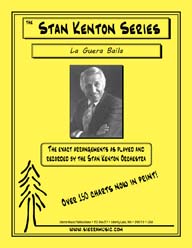
LA GUERA BAILA (THE FAIR ONE DANCES)
Recorded by Stan Kenton
Jazz Big Band Arrangement
Sierra Music
SMP-663
$55.00
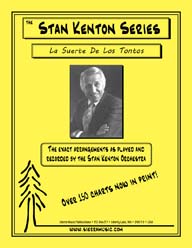
LA SUERTE DE LOS TONTOS (FORTUNE OF FOOLS)
Recorded by Stan Kenton
Jazz Big Band Arrangement
Sierra Music
SMP-664
$70.00
Recorded by Stan Kenton; Updated 2019 Edition
Jazz Big Band Arrangement
Sierra Music
SMP-667
$50.00
Recorded by Charlie Barnet
Jazz Big Band Arrangement
Jazz Lines Publications
JLP-8807
$95.00
Recorded by Charlie Barnet
Jazz Big Band Arrangement
Jazz Lines Publications
JLP-8807-DL
$95.00